Enhancing Ad Intelligence: Spotify’s Multi-Agent System
Introduction
In the competitive landscape of digital advertising, relevance and efficiency are paramount. Spotify, a global leader in audio streaming, faced a structural challenge: delivering smarter ads without compromising user experience. This is not a story of simply bolting on an AI feature; it is about rethinking the underlying architecture to create a system that adapts, learns, and optimizes in real time. The result is a multi-agent architecture that powers a new generation of advertising intelligence.
The Challenge: Beyond Traditional Ad Serving
Traditional ad platforms rely on monolithic models that process all signals in one go. This approach struggles with complexity: user behavior, context, inventory, and advertiser goals interact in non-linear ways. Spotify’s team recognized that a single, centralized model could not handle the dynamic nature of audio advertising, where timing, mood, and device matter as much as demographic data.
They needed a system that could:
- Adapt to each listener’s current context (e.g., workout, commute, relaxation)
- Balance multiple objectives: user satisfaction, advertiser ROI, and platform revenue
- Scale across billions of streaming sessions without latency
The Multi-Agent Architecture: A Decentralized Brain
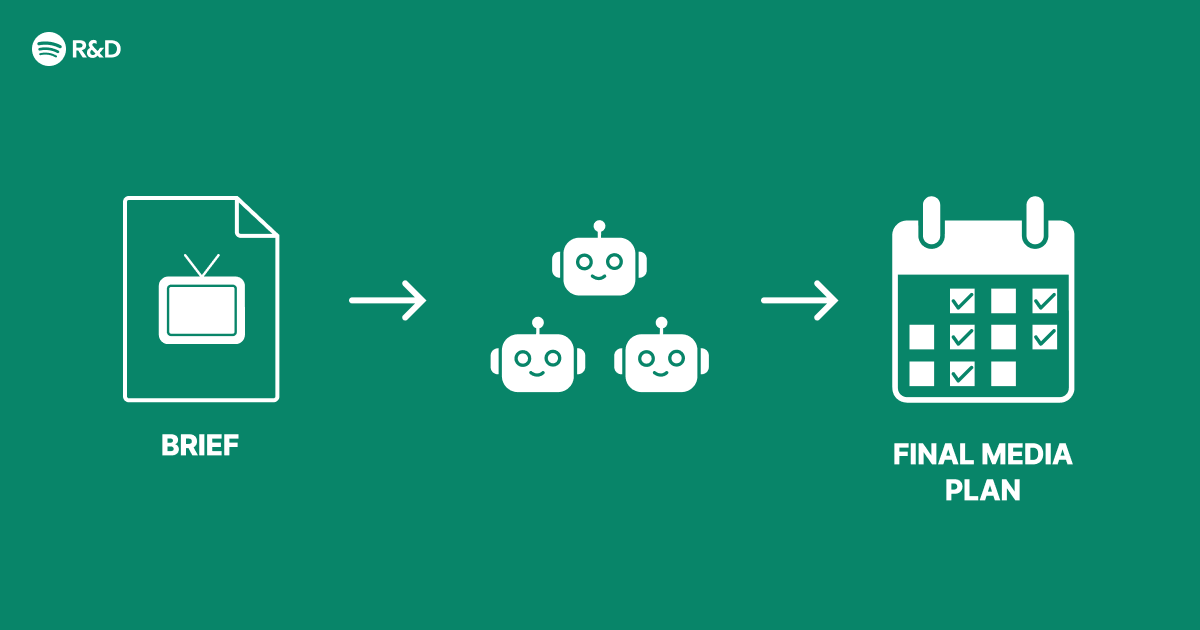
Instead of one monolithic AI, Spotify’s solution distributes intelligence among several specialized agents, each with a distinct role. These agents collaborate via a shared coordination layer, much like a team of experts discussing a complex problem.
Agent Types and Their Functions
The architecture comprises three primary agent categories:
- Context Agent: Continuously analyzes real-time signals – device type, time of day, listening history, and even genre shifts. It builds a snapshot of the user’s current state.
- Inventory Agent: Manages the ad supply pool, forecasting availability, pricing, and relevance scores for each ad slot. It uses reinforcement learning to predict which creatives will perform best under current conditions.
- Objective Agent: Represents advertiser goals – brand awareness, conversion, or engagement. It negotiates with other agents to satisfy constraints like budget caps and campaign KPIs.
These agents communicate through a message bus that prioritizes low-latency decisions. For instance, when a user starts a playlist, the Context Agent flags a “high-focus” scenario, prompting the Inventory Agent to avoid disruptive ads and the Objective Agent to prefer subtler brand messages.
Coordination Mechanism: Multi-Agent Reinforcement Learning
The agents are trained using multi-agent reinforcement learning (MARL). Each agent learns its policy independently, but a shared reward function encourages global optimization. This avoids the pitfalls of greedy local decisions. For example, the Inventory Agent might learn that serving a high-price ad leads to user skip, hurting long-term engagement – so it defers to a lower-price but more relevant alternative.
Real-World Results: Smarter Ads, Better Experiences
Since deployment, Spotify observed:
- 30% improvement in ad recall among target audiences
- Reduced skip rates by nearly 20% as ads became more context-aware
- Advertiser satisfaction grew, with campaign completion rates up 15%
The system also proved resilient to spikes in traffic during events like Spotify Wrapped, thanks to its distributed nature.

Design Principles Behind the Architecture
The multi-agent approach wasn’t accidental. Three principles guided its development:
- Decentralized control – No single point of failure; each agent can operate independently if the network degrades.
- Emergent intelligence – Complex, optimal behaviors arise from simple agent rules and interactions.
- Human-in-the-loop – Advertising teams can override agent recommendations through a dashboard, ensuring alignment with brand safety and strategic priorities.
Comparison with Other Approaches
Unlike traditional monolithic systems, this architecture allows for rapid experimentation. New agents can be added without retraining the entire network. It also outperforms single-agent reinforcement learning in multi-objective scenarios, as agents specialize rather than compromise.
Lessons Learned and Future Directions
Building a multi-agent system at scale taught Spotify several lessons:
- Debugging is harder – Agent interactions can produce unexpected results. Robust simulation environments were essential.
- Communication overhead – The message bus had to be optimized for speed, using compressed protobufs.
- Interpretability matters – Each agent’s decisions are logged, allowing engineers to trace why an ad was selected.
Looking ahead, Spotify plans to integrate federated learning so that agents can learn from user interactions without centralizing raw data, further respecting privacy.
Conclusion
Spotify’s multi-agent architecture for advertising is a testament to the power of distributed intelligence. By treating ad serving not as a single AI problem but as a coordination challenge, they achieved smarter, more personalized ads that benefit both listeners and advertisers. As streaming evolves, this approach may become the blueprint for the next generation of context-aware platforms.
Want to dive deeper? Explore Spotify Engineering’s blog for technical deep dives into MARL training pipelines and message bus design.
Related Articles
- Mastering Excel Paste: Beyond Ctrl+V
- 10 Essential Facts About the Linux Tool That Lets You Mix Distro Packages Safely
- PCIe 8.0: Unprecedented Speed May Force a Connector Revolution
- Revolutionizing Group Searches: How Facebook Unlocks Community Knowledge
- Cultivating Kindness in Digital Spaces: The Vienna Circle's Lessons for Web Design
- Agentic AI for Marketing: How Adobe, NVIDIA, and WPP Are Revolutionizing Creative Production
- Why I Switched from Kindle to Boox: The E-Reader Amazon Won't Build
- How to Transform System Tools from Chores into Desirable Experiences: A Step-by-Step Design Guide